Episode Transcript
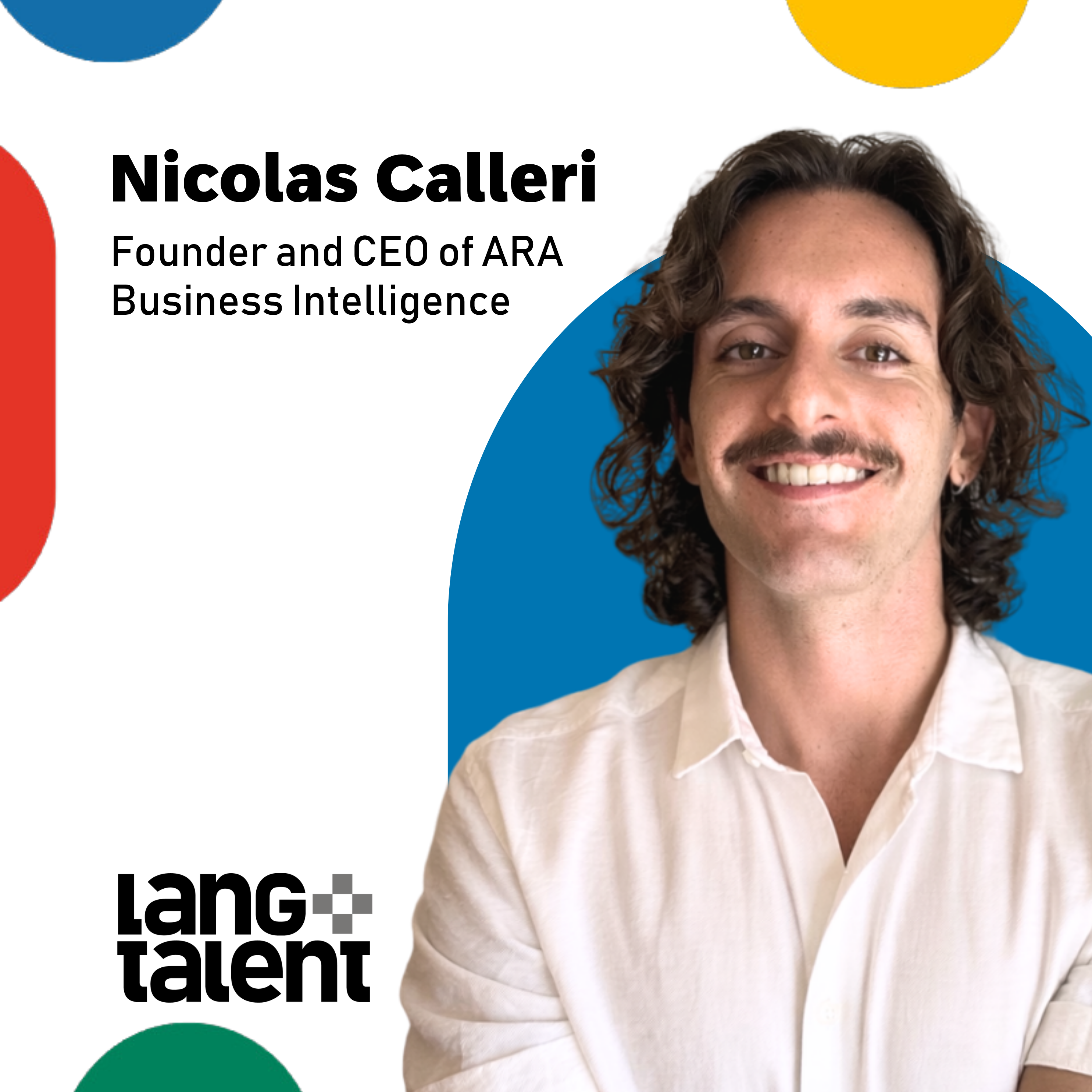
[00:00:05] Speaker A: Hello. Hello and welcome to Lang Talent, the podcast by Multilingual Media, exploring the human side of the language industry and the future of work. I'm Eddie Arrieta, CEO at Multilingual Media. Today's conversation is about something many professionals think about, but few act on. Leaving behind stability to build something of your own. Our guest is Nicolas Kelleri, founder and CEO of ARA Business Intelligence. Nicolas path into the language industry wasn't linear. From working as a waiter and a hotel receptionist to playing music in bars and eventually growing into leadership roles before taking the leap into entrepreneurship. In this episode we'll explore risk, mentorship, leadership, and what it really takes to to move from a stable career into building something meaningful from scratch. Nico, welcome and thank you for being here.
[00:01:01] Speaker B: Eddie, thank you very much for inviting me. For me, it's a pleasure being here today and yeah, looking forward to start.
[00:01:08] Speaker A: Oh, fantastic. And for those that might not know this, I met Nico Abamos Juntos, Buenos Aires. I love Buenos Aires. Nico, you are 100% Argentinian. Is that how it is?
[00:01:20] Speaker B: 100% Argentinian?
[00:01:22] Speaker A: Yeah.
[00:01:23] Speaker B: That event was great. And I'm also going to talk about the. I really want to mention how important it is to go and network and go to this type of events because that's how I meet you. And now I'm here.
So kudos for Vamos Juntos and it is great.
[00:01:39] Speaker A: Nico, I think you are completely right. It is incredible to meet new people and you never know what you can get from these events. And look at Nico here having a conversation with us in Lang Talent. Nico, of course many people know you in the industry, some others don't know you. But even for people that know you in the industry, could you tell us something about you that we might not be aware of?
[00:02:05] Speaker B: So something about me? Well, let's start with the standard. I have a bachelor in Business administration, but I'm going to throw some random parts over over there that I have two chihuahuas. You can see one. Then down the meadow and in the back, two chihuahuas. I have. I come from a big family in the north of Argentina. I love music. As you mentioned, I was playing bars before I had a band.
I was a lead singer and guitarist, so I love to do that in my free time. I love walks, going to the gym.
Yeah, I was this close to being a musician, but I ended up in the language industry out of nowhere.
So yeah, that is. I don't know.
[00:02:55] Speaker A: That is really good. We've heard so many times in the Lang Talent Podcast how so many of us End up in the industry by chance, then once we are in, it's so difficult to go somewhere else. But of course you enter the language industry. Tell us a little bit more about that. How did you get into the language industry and how did you go from entry level roles to into leadership positions?
[00:03:20] Speaker B: So as I mentioned, it was out of nowhere.
I was 24 years old. I was looking for a job related to my career because as I mentioned, I started business administration, business management. And I was working playing guitar as a hotel receptionist at the time. And I wanted to have a job with related to what I was studying, right? And out of nowhere I saw in a post they were looking for someone that can speak in English, have a visa and have a bachelor in business administration. But they didn't know anything about the language industry.
And I applied and after six months of interview, I was the one that got chosen. I was very lucky. And when I met this company, they flogged me, they bought me a ticket train. I went to Washington and spent two weeks with that whole team with that company. They told me everything that I needed to know. And I started as a records clerk. I was the one collecting all their vaccines for interpreters so they can go and be compliant to go to hospitals, hospitals like John Hopkins, MedStar, NIH, all the big hospitals. But I was very curious on how many interpreters we have compliance, right? How how many are missing some vaccines. And I started building reports on very basic stuff, right? And I started very, very, very interesting about this, how we can apply these numbers to strategy. And I started doing that in my department and then started knocking doors around the company like, hey, do you want to start? If we want to start measuring this, we can improve your development.
And by doing that, focusing on data analysis and business intelligence, spreading that around the company, that's how I started, you know, involving into that direction.
I'm very proud to say that. Yeah, in two years I started as a records clerk and I end up being the director of operations of that company. Because how we apply that system in a very tiny department.
We started applying that overall across the company and we started growing, growing like crazy. We skyrocketed that company. The performance, the financials, we were tracking the right things. We were providing feedback to the rest of the employees on their performance.
We created a decision system that we were reviewing our numbers like very religiously and it was great for me, I am extremely passionate about that, improving businesses. And that's how I end up being the director of operations and having almost without taking into account the linguist, almost 80 people reporting directly to me with 27 years. So it was quite the journey.
[00:06:20] Speaker A: And it sounds like quite a journey. And of course, in retrospect, when we look at things, sometimes we are able to then connect the dots. And that's what they say, right? You cannot trace a line into the future. You can only connect them backwards. What are some of the key moments where you said, you know, things started happening, you know, things started moving in the right direction with you? Are there any moments that you can think of that were really important for you in that process already?
[00:06:51] Speaker B: Definitely. I have one that really changed my life completely. There was a project, I remember this very clearly, June 13th, the year of the pandemic. I was at home and I wanted to build a call center, right? I have five interpreters, and then I receive a call. Hey, Nico, we don't need interpreters. We actually need transcribers. Do you know how to do transcriptions? And I said, of course. As soon as that call ends, I started googling how to do a transcription.
What I did is we started receiving transcriptions, and it was transcriptions from the jail, right? We started receiving calls from inmates.
I started building a team in Argentina, and I started with only five transcriptioners, and we end up being more than 80, working from Monday to Friday. And I was leading that team, right? So that moment was key in my life. Because I was 25, I never leave a team. It was all brand new for me. It was a huge.
Out of five to 80, it was a huge change. And I was leading that, that project, all the people. So that was a key moment of my life in which I learned that, hey, I can do this. Maybe I have a talent to do this right? And I'm very passionate about this. And that's when I discovered that I really enjoy doing that. So that was a key moment, maybe the most important moment of my life.
[00:08:25] Speaker A: I would say that's really important. It seems like it really changed and it gave you a great opportunity. And of course, you've mentioned passion a few different times. And it talks a lot about the attitude towards things. It says, you know, some people say hire for attitude, and then the skills can be taught.
And of course, attitude is something that I can see definitely helping you in this success.
Are there added to your passion, Are there other elements that you think have helped you in this process in the past few years to be where you are and to take the decisions that you have taken?
[00:09:01] Speaker B: Boldness, I will say boldness. Go all in with everything. Go in that for sure. I know that that is very rel related to passion, but I will say that that is a big one. But also take the time to stay calm. You know, stay calm, take my time to think, strategically, review things. Because, yeah, if you're bold, passionate about it, you. You will go all in, 100%. But it's very important to take it down to actually seeing what you're doing, if you're going the right direction, how you can improve it. So I think that analytical skill is something that. Yeah, it's really helpful.
[00:09:46] Speaker A: It helped me a lot, and it's great. You're talking a lot about balancing yourself out and bringing things that can put you in the right places. And it is often, and we've seen it here in Lang, talent, as we talk to talent of different walks of life, different levels of experience, that it is also true that, you know, the context that surround you, the people that surround you, become really important in your journey. And you've mentioned the impact of mentorship and mentors to your journey.
What did the relationships teach you? What can you tell us about the mentors in your life?
[00:10:24] Speaker B: Well, I had one that was crucial for me. Crucial. I have great mentors in my life. And let me tell you something. I believe that you become the average of the five people that you hang out the most with. Yeah.
So it is great to surround with people that they are more intelligent than you, more talented than you, so you can actually learn from them.
But as I mentioned, I have one mentor. He's going to. I'm going to send him this podcast as soon as his release.
That guy taught me a lot of lessons. He saw a lot of value and potential in me that I wasn't seeing. So he pushed me. He helped me to become more confident. He gave me a lot of leadership lessons, how to act in different situations that I never experienced before, and I didn't know how to manage at that time.
He was very calm with me, taught me everything, step by step, and he made sure that before he left the place that we were working together, I was very established in my role because I was assuming a big role at the time. And he was a consultant, so he put me under his wing. And right now, he's like a second father for me. So then, if you're seeing this, I love you, man.
[00:11:48] Speaker A: That is really great to hear. Of course. And it seems as well that this type of mentorship helped you go into places where you were not familiar with. And I think people can get the wrong idea by thinking, oh, Nico, Is just very comfortable in every single situation.
Can you tell us a little bit about being comfortable versus actually challenging yourself? You and sometimes you're just willing. Your boldness puts you in these places and it gives people the idea that it's just very easy, that it is comfortable. But it's not always the case that it is comfortable. You got to learn things along the way. What can you tell us about that?
[00:12:28] Speaker B: It's not comfortable at all. Taking risks is not comfortable. If you stay comfortable, you are not going to be achieving a lot of things. That's my personal thought, right. Taking these risks. Who it's fearful sometimes. I was scared a lot of times on taking this those steps. For example, when I quit the place that I was working, that I had a great position, a great titles. I was working with people that I love in a company that I enjoy a lot. I was traveling to the United States like four times a year.
And I love traveling. I was even playing guitars at event in the United States. I see your guitar in the background. I was going to events in the United States and play guitar live in front of people. Eddie, it was amazing. Imagine how comfortable I was when I told my father and my mother that I wanted to quit. And I was scared because I was living this way situation. They say, no, Nico, don't do that, don't do that. Everybody told me, no, no, no. It's a huge risk. But I had this extreme like burning desire inside me that I wanted to go and explore what could happen if I take this risk and create something meaningful on my own. And if it wasn't comfortable at all, it was a huge risk and I was extremely fearful. But I ended up doing that because I rather try that live with maybe years of regret of not knowing what could have happened.
[00:14:09] Speaker A: And that's a huge line there. Would you rather not do anything and regret it for the rest of your life or take the leap of faith and look to do certain things and for certain people there is this burning desire to do it and there is nothing that can stop you. And sometimes you don't wanna. You say, okay, I'm gonna take a pause in leadership. I'm going to take a pause in doing the thing that I feel like I should be doing. And then you can't stop yourself.
That burning sensation gets you to go in the direction where you should go. And Nico, I want to explore that a little bit more. Because you had that stability.
Yes. Your mentors were putting you in places where you tried new things and that stability is really attractive. You want to stay there for a long time.
You know, what was other than the desire and the fear of the regret rather than the fear of, you know, the stability that you had there? What, what really pushed you to move in that direction? What were some of the moments where you finally said, okay, I'm doing it. How did that happen?
[00:15:18] Speaker B: Well, it happened last year that I was seeing that. Yeah, I was in a great place. I was actually. They created an environment in which I was able to create stuff, but I reached a limit. I reach a limit in. In which I said, okay, what else is there for me? Is there something else in there for me? Am I going to change job to another company? Because that was another option, right? Explore another company, another industry. But I love this industry. I know this industry.
And I said, it's. It's about time. If not now, when?
But then my, my, my thing is that I think I reach a time that I think it needs to happen. Right now, I didn't receive like a huge signal or any key moment. It was just me being tired of doing the same and holding myself to do this because I was fearful, Eddie. I was scared because I had this huge.
I was in my comfort zone, in a great place.
I was very fearful. But I'm glad I took that step. And I am exploring this world of entrepreneurship right now. Going to events, do sales, meet clients, prepare proposals, doing everything on my own right now while I'm building a team, trying to get more clients.
Now I wake up with adrenaline right now. I am living some. I am experiencing a lot of different emotions right now. And at the end, that's what you. When you die, this is what you. What you get, right? All the lessons, all the moments.
I'm being honest with myself right now. I'm staying honest by doing this.
[00:17:13] Speaker A: And Nico, thanks for sharing that, because that's one of the things that we also see in those that succeed in building their careers. And it's not about the size of the career, but rather how genuine, how unique is that path that you're taking? And it's your path, and it is great to see that along the way. You are in the industry, you could have gotten opportunities in other industries. You could have started a business in another industry.
Yet because of your experience in the industry, you saw an opportunity and then you chose to build ARA Business intelligence. Tell us a little bit about why you focus on business intelligence. Why did you stay in the language industry?
[00:17:58] Speaker B: So let me tell you a little bit about ara. So we help language service companies to have A clear understanding on how their business is performing by tracking, measuring and improving what really matters. We do that by gathering all their data that they have spread around all the different platforms that they work with. We centralize it into one single source of truth. And after that we create useful and automated reports that provide leadership the visibility on how their business is operating. We make them more confident to take data driven decisions. And we also eliminate a lot of hours of manual report like giving people freedom to instead of cleaning a spreadsheet, they can go and do other stuff.
Why business intelligence?
Because I applied this from a very tiny department at the company that I was working before. I spread that around the whole company and I saw how we were improving as a company.
We started measuring stuff that we didn't measure before, like key indicators.
Right.
There are a lot, I'm not going to start mentioning them. I can spend hours talking about this. Eddie. That's how I love these numbers and I'm applying all of this stuff.
But we started applying these systems and we started growing and while we grow, people were getting better at their jobs. We started growing the business and growing the people and creating more opportunities.
Eddie we started creating jobs in Argentina for many young students that they were just graduating.
They didn't have a lot of opportunities in Argentina. We were in the middle of a huge recession.
So for me, being able to create all of those jobs, all of those positions, that for me was one of the most wonderful things and the most.
I cannot find the word satisfying. Satisfying thing. Most satisfying thing of my journey was how we were able to create a lot of opportunities for young people and also some old folks because we improve the business. If the business grow, the people grow. That's my, my thing and I'm very passionate about doing that. And I want to mention something real quick. Everything that I learned from my mentor for me is very, is great to apply that with the new people that I got to work with, with other people that start working with me. I apply all, all the lessons that I got from Benny with the young folks that join working with me.
I love applying that, transferring all the knowledge from him to them and having the same impact that these guys have with me when I have that impact with other people. It's like most of heartwarming.
[00:20:56] Speaker A: And of course I love to get a little bit into the culture of out of business intelligence and how the mentorship and the lessons that you've had have transferred into your team. And what does the culture look like before we get onto that? The language industry and all industries for that matter, because of the search of artificial intelligence, have gone into a place of panic, a place of fear, a place of, you know, where, where, where many companies have given up, many entrepreneurs have given up, many leaders have given up. And yet you have chosen to double down into the language industry.
What about the opportunity that you saw was interesting? It's unique that, that, that, this, that, that helped you make this decision to stay within the industry first.
[00:21:49] Speaker B: This is a business that was that what I do for my company, with my company, it can be applied to all the different, every industry. But I am choosing this industry because I know the industry, I love this industry and what this industry does, right, Creating language access, building the gap between communities. And I know that right now this industry is in the middle of panic because of AI. But I know that if the leaders of this industry can track how their business is operating, they can find some gaps on how they can be better and maybe survive. I saw companies that, they were struggling, but they were not measuring their stuff. They didn't know how their business was actually operating and were they failing and they end up crashing. And when, you know, you know what happened with business crash, people lose their job.
They could avoid that, they could avoid that if they, they actually be more strategic about their business.
So that's one of the reasons that I'm doing this.
I saw a lot of that. So there is a huge opportunity for language companies to apply business intelligence, to understand where they can improve. Right. And being able to forecast demand, how to grow their different departments, where to invest money, where to cut costs if needed and all that.
[00:23:19] Speaker A: Thank you. And of course, you did mention some of the things that you wanted to transfer and that you are transferring from your mentor onto the team that's working with you.
If you could help us understand a little bit about the culture and the way in which your team works today, what are some of the things that you would say are helping your team thrive in the current economic environment that we are going through?
[00:23:47] Speaker B: So they. First of all, I am extremely honest and directly with them. I explained to them the why of everything, the how so they can be extremely aligned with what we're doing and the vision of our company. Right. For me, it's very different if you tell someone what to do, but if you tell them what to do and explain the impact that that will have on the business, what we're trying to accomplish, and the impact that that will create across everywhere that we are working with, that make them inspire, right? They become inspired and they feel that they are a part of something. When they feel, when you feel that you belong somewhere, that feeling, you know, you start really showing up, you do the extra mile.
I encourage them to think outside the box. I encourage them to, you know, I push them a little bit to do more, grow their potential and, you know, being out of their comfort zone, it might be a little sometimes pushy, but that's how you end up growing. So I am very direct, honest, transparent and, you know, take them with me to this journey and they know that we are just starting, we're just finding our first clients, closing our first contract.
So they are joining a group that it will grow. So that is very exciting also for everyone.
[00:25:22] Speaker A: And I really hope, Nico, that you and your team find that success, that you consolidate your culture and the vision that you have for that organization.
And of course, there are many things that we always wish we did different. And we are the type of people, I can say, I can see that have no regrets. Life is the one that we've built and, you know, we find a way to tell it in a way that helps us cope with the mistakes.
What are some of the things that you see today that you wish you knew last year when you were starting Arab Business Intelligence? That can perhaps help, and this is what I'm looking for, that can perhaps help those in companies today that are looking to do spinoffs because there's so much innovation happening at companies.
Some people are staying in the companies, but they are starting the spin offs, new ideas within the companies. Others are leaving. The companies are doing new things within our industry and outside of our industry. What are some of the lessons that you have taken from this journey that you would say, okay, if I would be able to talk to my younger Nico, much younger Nico, what would I tell that young professional?
[00:26:36] Speaker B: This is very like personal phase for me. Start networking. Before, I was very comfortable only talking with the people inside the company that I was working with. But the importance about networking, if you're trying to create your own business after, as soon as you are thinking in creating your own company, start networking, start attending events. You even they are online events, start contacting people with LinkedIn. Start creating like a brand of yourself. But go to events, go to events, meet new people. Networking is key. And that's what I found out. As soon as I started with ara, I wasn't networking that much, right? But then I started doing more networking, attending online events. Then I meet you at Vamos Juntos and look at where I am right now. I met a lot of Incredible people during that event. So what I will tell myself is start networking, Nico. Go do it.
[00:27:39] Speaker A: Fantastic. Nico, thank you so much for this conversation. And we can't wait to see how the success of ARA Business Intelligence translates into success for your team. And even better lessons to come share here in Lang Talent. Nico, before we go, do you have any comments, thoughts, any advice you'd like to give to our amazing audience that have taken time to listen to this conversation?
[00:28:05] Speaker B: So we were talking mostly about entrepreneurship. So I will talk right now to the people that they are in the same position that I was before. Like, maybe they are in the comfort zone with their company, working in a stable position, but they want to take this step and they are in the middle of taking that decision or not. I will say life is one. Do it, but not recklessly.
Without thinking. No. Have a plan. Think very well. Do the analysis of what you want to do.
Save money to survive. Like, do your math. Save money to survive for at least three to six months, but do not wait.
Start planning and take that step.
[00:28:53] Speaker A: Thank you, Nico. Before we go, of course, where can we find more about Arab Business Intelligence and About Nico Calleri?
[00:29:00] Speaker B: LinkedIn. Searching LinkedIn. You're going to find everything over there. My webpage, maybe my Instagram if you want to hear my music.
I also have my Instagram over there, so LinkedIn is the place.
[00:29:13] Speaker A: Wonderful.
We'll take a link. Our editors will do us the favor of adding perhaps 20, 30 seconds, maybe a whole song by Nico Calleri at the very end of this recording. So go enjoy it and stick around for the end of this recording so that you can hear Nico playing with his band. Nico, thank you so much for doing this.
[00:29:35] Speaker B: Thank you, Eddie. Bye, everyone.
[00:29:37] Speaker A: Bye, everyone. Thank you for listening once again to Lang Talent. A big thank you to my friend Nicolas Caledi for sharing a story that many professionals can relate to the tension between stability and the desire to build something of your own. His journey is a reminder that careers aren't always linear and that growth often comes from stepping into uncertainty and trusting the value you can create. Catch new episodes of Lang Talent on Spotify, Apple Podcasts and YouTube. Subscribe, rate and share so others can find the show. I'm Eddie Arrieta with Multilingual Media. Thanks for listening. We'll see you next time and have a listen to Nico Caletti.
[00:30:36] Speaker B: I know.
Shiny.