Episode Transcript
[00:00:05] Speaker A: Hello. Hello and welcome to Lang Talent, the podcast by Multilingual Media exploring the human side of the language industry and the future of work. I'm Eddie Arrieta, CEO in Multilingual Media.
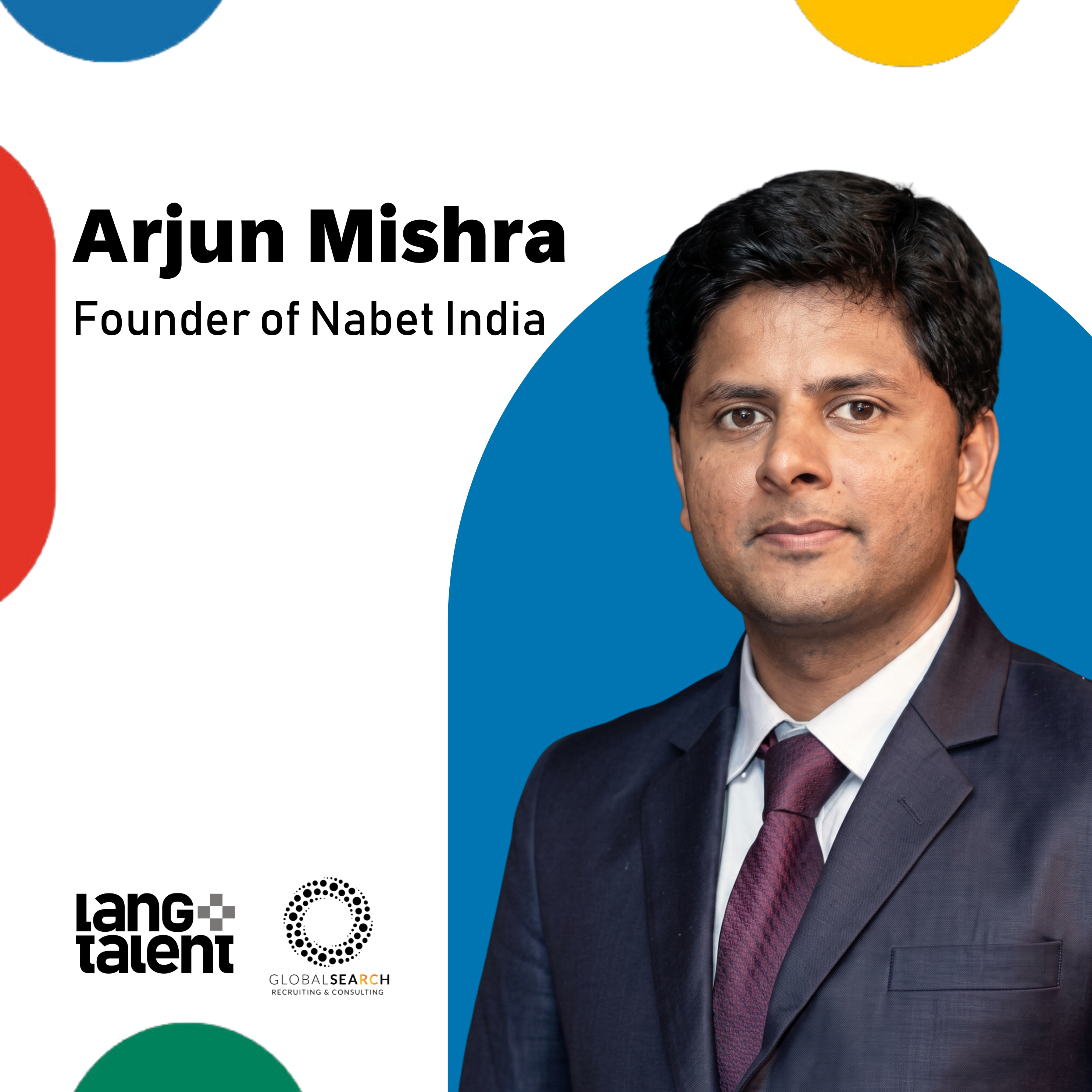
Today's conversation looks at a layer of AI that often remains invisible. The human work behind training, intelligent systems. And who gets to be part of that work. Our guest is Arjun Mishra, founder of nabet, an Indian based annotation initiative built on a simple but powerful idea that high quality AI can be driven by inclusive talent through a differently abled workforce. NABET is building a model that connects precision, process and opportunity, positioning inclusion not as a social add on, but as a core operational advantage. Arjun, welcome to Lang Talent.
[00:01:02] Speaker B: Thank you so much Eddie and all the viewers of Multilingual and the team at Multilingual for this wonderful opportunity this evening. Such a pleasure being here and talking
[00:01:10] Speaker A: to you all and that is awesome. Arjun, you've experienced firsthand how hard it is to put talent together, to make something happen. Absolutely. It takes coordination, it takes a lot, it takes a lot of effort to be able to do many different things. And you are at the core of talent identification, you could say talent exploration, talent prospecting. You are in also the work of helping allocate that talent, helping train that talent.
And we're grateful to have your insights today here.
To begin with, of course, I mentioned to you before the conversation that differently abled teams can mean so many things for so many people. What does it mean for you, Arjun? What does it mean for nabet?
[00:02:04] Speaker B: Absolutely.
So NABET stands for providing the much needed opportunity to a very deprived community. When we talk about people from the differently abled community in India, just to set the context, Eddie, this represents statistically from the government data, close to 2 to 5% of the country's population you're talking about, and that is the government statistics. Typically the numbers are way, way higher.
They are very less represented in the workforce. And at nabit, what we do is that we try to identify new revenues of employment where these people can be gainfully employed, where they can be leading a dignified life and where they can be contributing and respected members of the community. I think that is within the Venus initiative that NAVIT runs. The AI and the ML one, where we are working as data annotators for leading companies, is the newest and I think the most promising given the things of the future.
[00:03:01] Speaker A: And of course it's at the heart of one of the hardest activities to do today, the work that you are doing.
Of course I mentioned to you as well my current inclination to be learning a lot about annotation and where annotation is going. So how does annotation quality or if we can begin with what is annotation quality? The basics for those that are not up to date with the conversation. And how does it compare between differently abled teams and traditional annotation workforces? So what is it and what is the difference when executing these quality annotation or annotation quality tasks?
[00:03:48] Speaker B: Absolutely. So first thing first Eddie, when we talk about annotation for the much for the less initiated, assume that is the bedrock, that is the building blocks on which the LLMs work. So it's the data set, which is when we put up a prompt, the retrieved information. The quality of the LLM is as good as the data set to which it's created. And it's also dependent on how diverse is the data set, how contextual is the data set, how multimodule is the data set and the experience of the human experience which they will get to. The response of the LLM and what will be the greater definition to one versus the other is dependent on how well is the data set QA or rather quality checked on the basis of the human experience or the human loop in the quality feedback we speak about in the development of LLM. This is one task which is highly suited and done by differently abled here at Maverick. And we're proud to have been partnering with leading companies and also creating this ability in this opportunity deprived group.
The second question was around what is the contribution or what are we doing in the space of annotations or how is a differently abled more ideally suited for carrying out this task?
So Eddie, what happens is, let's understand it is not about whether it's the differently abled oil, it's the non disabled category which are more suited towards sanitation. It's the process which we have developed here at Mavic, it's the training infrastructure, it is the human feedback. It's about how well is their judgment, it is about having diversity in the data collection. These are certain factors which define how well the LLM works.
And of course when it comes to scalability of the model, when we're talking about an opportunity to provide segment and we bring opportunities to them, what happens is that these people value the opportunity given and once they value there is lesser attrition. So that drives quality and that drives something which is worthy for the parts and companies. Because once we scale these models and once we have lesser attrition, it becomes easy to Rely on the dataset created. That's something which uniquely NABIT offers.
[00:06:04] Speaker A: And of course we can read between the lines and talk about what differently abled professionals bring specifically to the table.
But if we can focus on the unique strengths to data annotation, if you could expand a little bit more on that, what can differently abled professionals bring to this conversation?
[00:06:27] Speaker B: Absolutely. So something which is unique to differently abled is, for example, if you take the case of a neurodiverse audience, repetitive tasks and which is an eminent part about when it comes to data annotations and is also the major reason why people are leaving this industry or workers lead this industry is that boredom sets in with repetitive tasks. Now that is something with uniquely a neurodiverse audience for a person with, you know, speech and hearing impairment has greater focus on the work which comes which is given to them. So I don't say that, you know, we say at Navid that if one sense is taken away from a person, this other senses become more stronger. Now when it comes to repetitive tasks, I think a neurodiverse audience or a speech engineering impaired person is more rightly suited given his strengths.
And that is something which reflects in the data quality which we generate in the data set which generate for the improvement of the LLMs. So I don't say that it is only to do with the fact that what uniquely does are differently able to build, but it's the complete infrastructure which we have created here at NABIT in terms of the training infrastructure, in terms of identifying new resources, in terms of the skills which we imbibe in them and the real life experience which they have working on LLM models which uniquely defines a very compelling reason for companies to participate in our mission.
[00:07:52] Speaker A: And clearly there is a huge opportunity right now because of the moment that we're going through history.
Arjun, this seems to be a very unique case study, a very unique situation where you've identified an opportunity. Before we continue, just to give some context to the listeners, tell us a little bit about you. Who are you? Who is Arjun? How would you describe the things that you do and why are you doing this type of work?
[00:08:24] Speaker B: It's a personal story if you allow me, Eddie, to share.
I lost my grandmother.
She was a person who had low vision and eventually it was with a condition called they progressively lose their eyesight with glaucoma and that because of that glaucoma which she lost her vision eventually it was also the reason for her death.
Now the death of my, who was very close to me led Me to being very passionate about the mission and where I was trying to uniquely identify what is that problem which Arjun can uniquely solve.
I felt when it comes to employment for these differently abled and employment just not something which can be limited as tokenism something which should be driving value and something which should be future leaning should be something which Arjun should be creating. So journey which started with providing contact center operations in the past and then eventually now when we're talking about AI and ML which is the future and I feel a sense of pride and passion to say that we are building the LLMs for the future we are also building physical AI and we are working. So something which is unique to what we are doing and I think it's important to mention is that we are based in the industrial township of India and because of this we are in a complex of industrials diverse industries so we have garment industries here and there's a lot of interest now as you would be aware also in physical AI. So it's via our differently abled the outreach which we are doing we are also collecting data sets for industrial training here at nabit. So there is something which is a combination of the. It started from data labeling initially now from data annotation which we've been, which we are being frequently now participating in and the next loop which I see which the next horizon is around physical AI which we are working towards.
So I see that the pride which a person with disability takes when he mentions to his peers that I don't know about you but I'm working in the industries of the future I'm creating those LLMs which will be used in the next generations and in the story of change I have a unique chapter in spite of my disability to contribute. I think that's something which is passionate and is something which I think is applicable and we should bring new opportunities to bear.
[00:10:44] Speaker A: Absolutely. And of course there are assume very different lessons that you have taken from the work that you've done with differently abled professionals. What can you tell us about what you've learned throughout this process? Perhaps in attention, partner recognition, consistency. What have you seen that have surprised you and humbled you? I guess as well?
[00:11:09] Speaker B: Absolutely. So something which I think is unique and which I'm very proud of. They have a strong statement to prove for their lives they have something to prove to the society at large that do not consider us as people who can't contribute. We have our unique strengths. The question is will you give us the opportunity to prove and I think that's something which they, they do deserve. And once a person is out there to prove a point in his life that it is not meaningless, but can actually be a huge contribution in the technologies of tomorrow, I think that is something which, whether this mission succeeds or fails, if I've just written a chapter in it, in terms of bringing these people to an opportunity, in terms of the success which I've been able to taste in the last four years, I think I've already ticked my boxes of what have I done for my lifetime. And I think eventually there is a lot of scalability out there which can be done with newer models. And given their demography and background, these are engineering grads. These are grads who started engineering, but unfortunately, given the disability, were not given a chance to prove their point and are now contributing towards the creation of LLMs tomorrow. And that's something which is uniquely driven by the differently ableton. Nadia.
[00:12:23] Speaker A: And perhaps one of the first times in history where the differently abled have been able to record in a digital grid that the impact is there because in previous decades, centuries, it has been impossible to track any of the contributions of the differently abled communities around the world. I presume that's probably the case. And now there is an opportunity here to do that.
[00:12:51] Speaker B: Eddie, just imagine from consumers of digital data and infrastructure now being a part of the creation process. Think about the tectonic shift which we are now creating for these people thanks to technology and thanks to the opportunity which we are bringing. I think there's a huge success here, which we are which. And the. And the opportunity which you're bringing to them and given more industry participation. I want to touch more lives through this mission. And hopefully that's what, and that's what I think was God sent to have been built in the times that we are and the success which we have got.
[00:13:24] Speaker A: Yeah, definitely.
It seems to me, it sounds to me like we are coming into an era where different levels of intelligence, different levels of talent would be able to shine. And because of the different tools that now we have to do at that. In particular, we've of course passed times in our human history where being skilled with your hands is what differentiated you from anybody else.
And then we move toward other periods where being great with your mind then turns into something that's relatively more important. We still value physicality. We still value athletic strength. We still value artisanship and handcrafted.
I think we are coming to an era where that's gonna continue to be invaluable and even more valued than before. But also Means that humans in all our beautiful diversity will be able to express their talents in different ways. There are going to be challenges, clearly remote annotation when we start thinking about larger scale, different intelligence coming on board.
Do you think it's a sustainable model for inclusion? What needs to happen to make it even more sustainable, if I may?
[00:14:52] Speaker B: Absolutely. So there are multiple things, but something which comes to the top of my mind is being protected or what means can be done in terms of when we are having workplace accessibility or we give them opportunities to work remotely, how do we also protect the data which we are, which we are providing to them? And there are solutions of course, which we have devised, but there's of course more progress which needs to be done in that direction. That said, I think this is absolutely scalable because eventually the success of a LLM model depends on how soon can you bring the product to the market. That said, it also depends on how reliable and how scalable is the is the workforce which is building it. And if there is a solution which can be made inclusive, which we also create opportunities for the differently abled, given their unique ability.
And these are passionate people who have not been given opportunities in the past. So this creates a very unique talent pool which has not been utilized in the past. And if they can drive value in terms of providing the necessary human feedback to the LLMs and contextual feedback to the LLMs whilst creating an inclusive solution, I think with the challenges still it provides or offers a great opportunity to engage.
[00:16:11] Speaker A: It's of course a technical challenge in many ways. The training challenges in many ways are very salient there in terms of infrastructure. And I'm curious from the city development level, we are having here a conversation about the inclusion of your citizens into the workforce.
What are some of the considerations that city planners and technology planners at the public level would need to be thinking about in terms of political infrastructure or policy? Infrastructure and also tech infrastructure. I mean for us to have this conversation we need a camera, we need headphones, we need Internet. There are things that you need there.
What should we be thinking about as a society?
[00:16:59] Speaker B: No, absolutely. I think the problem of unemployment amongst the different E able is just not an Indian problem. It's a worldwide problem. Right. The representation, if it's less in the Indian workforce, I think the same problem might be in South America. That may be the same problem in other continents too. Now what we are creating here, Eddie, is a solution. It's the proof of concept which needs to then be replicated in other parts of the world. Because when we talk about contextual AI and when we talk about diversity and we talk about data set creation, how can we not think about that something which may be working towards and we're talking about human feedback. Hence a data set which might be created for an American audience might not be uniquely working to the expectation of an Indian audience or rather some other, some other place, let's say in Brussels. So we need solutions wherein we incentivize maybe from a political level or from an institution level or a government level. Maybe we incentivize corporates to open opportunities for data annotation for the different labeled. We also incentivize them for creating more opportunities in other roles beyond just data annotations too. But then this is something which we have already proved is successful. This needs to be scaled. And then we can also emphasize about the value generation in terms of what is there for the companies. It's about the trueness of the data. It's about how effective the new elements which are generated with the help of different three able. And then there are organizations like NAVIT which have a, which have the solutions. Of course I'm not saying that it's a hundred percent there, but we have to some point to some level able to solve the multiple challenges which is there towards creating an inclusive workforce. And we can't emphasize more on the advantage of less attrition about more neurodiverse audience and their unique strengths which they bring in the data set generation. So there are advantage for all stakeholders, may that be. Sorry, you were saying something?
[00:18:46] Speaker A: Oh, please go. So you were talking about your stakeholders?
[00:18:49] Speaker B: Yeah, I think there are the advantages for the companies, there are advantages for the, for the institutions, there are advantages for the government at large for creating this model and incentivizing the corporates to participate in it.
[00:19:03] Speaker A: I find very fulfilling to start looking at remote work as a possibility for inclusion. We've known this for many years and we've looked into what are the potential opportunities that can bring dignity to the lives of those that require in some cases a home office.
Some of us wouldn't be able to work unless we had this possibility to work remotely.
Inclusive digital workforces then can become a standard model. And now specifically, specifically to AI development.
Do you think this to be a true statement? What are your thoughts?
[00:19:47] Speaker B: No, absolutely, Eddie. I think this is the way for the future. With all the bad things that Covid brought, there was something good which eventually was also driven for our definitely able audience that eventually when it was about them working from office and being rejected at Times because not being logistically possible for them to transfer to travel each day. Once Covid hit a remote workforce or people working remotely from home became the norm. And then there were many opportunities which were initially denied for differently able because of their inability to travel to work was suddenly offered. And I thought, and I think the success which we are seeing now in data annotation and other scopes there has been also, you know, attributed to the fact that when companies started considering the fact that yes, productivity can also be generated in spite of the fact that people aren't reporting to office, I think that mindset shift became an important aspect which companies started considering that if people can contribute and if we can ensure data security and other aspects of it, then why not give the differently abled who are there to prove a point an opportunity to prove it. And companies have tasted the success of it. I can, I can go on and on about, you know, the advantages which, which comes with a nutrition proof manpower which comes about with the person who's out to prove that this person is deserving for the role which is given to them and, and also someone who sticks to the company for long. So these realities aren't there which in the far future they are successes which we have generated. And I think it's also advantageous for the companies to indulge in this. And when we talk about the infrastructure changes which are required, I think we have that labor quality in place. It's just about replicating it for the various organizations which might be interested to participate.
[00:21:25] Speaker A: And that's wonderful to hear Arjun. Clearly all of the actors in the chain are very important from academic institutions to companies to governments.
And of course for those that train the talent outside of universities, that do more on digital side of training, what are some of the things that need to happen in terms of articulation, coordination, development of solutions for, for these conversations to scale globally and of course for the execution of something like this to scale globally.
[00:22:03] Speaker B: I'm a very strong believer in the statement Eddie, that to some extent business solves everything. So what I mean by that is if we create and if we have those companies who have an interest that given the challenges, let's give that opportunity because we believe that this thing can deliver then all the other aspects when you talk about development of this talent pool, when you talk about the infrastructure challenges which go about it, eventually if you make a decision that these solutions can work and we are ready to experiment with it, then and we start with a few small successes like what Nabit has delivered, eventually that Start creates the confidence in the boardroom that this is not intense and hundreds, we are looking at thousands of employments which can be generated in the space. And this is not a use case for charity, this is a use case for value for the companies to, to look into. So you know a demand for those talents can eventually create the infrastructure which are required. We have, we have these successes, we have the, the you know, academia which can back us with those talents. Given the fact that we create the, the demand that yes, we are interested in this talent pool and yes there may be some customization in terms of training and other things which are required. But let's start with the first step and let's solve the chicken and egg story. Who goes first? Let the company start creating those opportunities first.
[00:23:20] Speaker A: And it's wonderful, like I said, to hear there's a development on the conversation. We are happy to have you with us today. Arjun. Before we go, is there anything you'd like to add? For those listening, for those wondering, okay, how do I get involved in whichever part of the cycle chain, Whether you're talent listening to this, whether you're someone who knows someone who could be of something like this, who can be part of it, how can, how can we do something?
[00:23:52] Speaker B: We need all stakeholders on board. This is a mission which is not, it's a, it's a humongous task. I need more hands on board. I need the participation from corporates, I need the participation from academia to replicate the skill training program specifically and customize it for the unique audience that they serve. We also need you know, the participation from the institutions and the government in general to create the use case for the success. And I think that falls in the hands of policy.
When we talk about we being conscious or we being empathetic to the cause or differently abled, we need to walk that talk. We need to create the infrastructure policy wise for tasting those success. Else Nabit might reach a few numbers but then the future that I foresee in terms of having scalability in place that I can, I can proudly mention that we have across, across every continent a success story to prove and I have across, you know, I have created a solution for a differently able C start sitting in Brussels, sitting in America, sitting anywhere in this world that he can choose to be a, to transform his life. He can choose to be a contributor for tomorrow's technology if he wants to because that infrastructure is already in place, that solution is already in place. And we have heard about Nadit's story then why not here? I think if you can create that, why not? I think we have made a success
[00:25:11] Speaker A: and I think even now you've already become a success.
Case study that needs to be understood. A case study that needs to be followed and we are glad to be able to hear the story here in Lang Talent. Arjun, where can we find you? What's your website, what's your social media? Where can we find you on LinkedIn as well?
[00:25:33] Speaker B: Yeah, I'm of course on LinkedIn. The website goes as nabitindia.org you can always reach out there for viewers of this, of this podcast. I make an appeal. Again, this is an all hands on board mission. We need you here, we need you. Whatever part of the life cycle you can help us with, we are more than interested. Wherever you're based out of, in whichever continent, we need you for seeing the success.
We have an opportunity today to transform the life of the differently abled. They deserve the much needed opportunity. Let's create it for them.
[00:26:07] Speaker A: Thank you Arjun. And of course with this we come to an end of our conversation.
So thank you for listening to Lang Talent. A big thanks again to Arjun Mishra. Thank you Arjun.
[00:26:21] Speaker B: Thank you so much. Pleasure connecting. Thank you so much.
[00:26:24] Speaker A: Good viewers of course, of course. And thank you for bringing visibility to the human layer behind AI and for showing how inclusion, when designed intentionally, can become a source for both quality and opportunity. Remember to catch new episodes on Spotify, Apple Podcasts and YouTube. Subscribe rate and leave a review so others can find the show. I'm Eddie Arrieta with Multilingual Media. Thanks for joining us. See you next time.