Episode Transcript
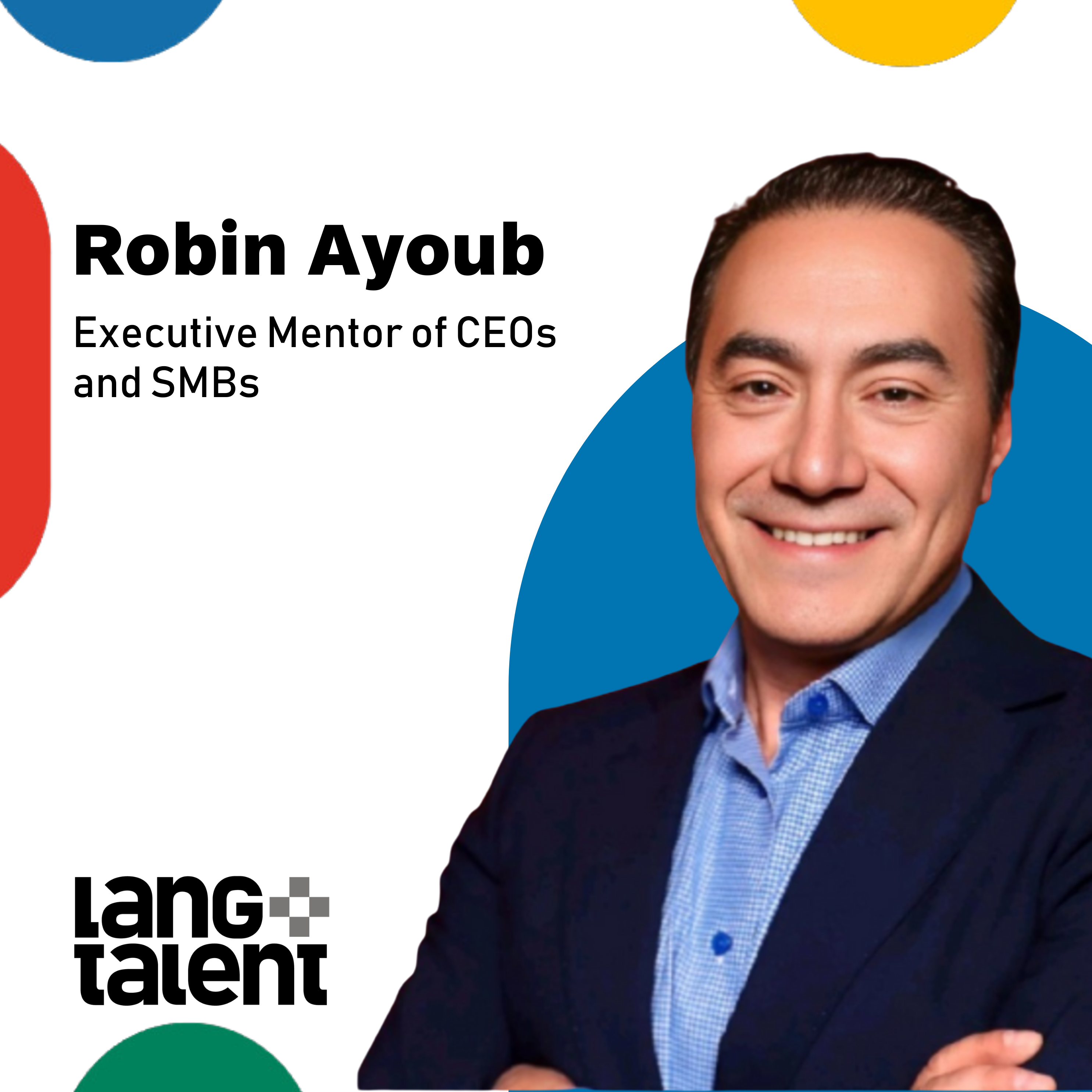
[00:00:05] Speaker A: Welcome to Lang Talent, a podcast by Multilingual Media exploring the human side of the language industry and the future of work. I'm Eddie Arrieta, CEO at Multilingual Media. Today we're talking about what happens when real world pressures, AI tighter budgets and global expansion collide with the work of language professionals and companies around the world. Our guest, Robin Ayub has seen that transformation from every angle as an executive in major LSPs and advisor, helping companies shape, go to market strategies for language and AI services. And the host of Localization Fireside Chat, a podcast where he's been chronicling the industry's shift towards smarter, more aligned operations. Robin, welcome. Thank you for joining us today.
[00:00:52] Speaker B: Oh, thank you, Eddie, appreciate it. Thanks for having me, of course, to.
[00:00:56] Speaker A: Be with you, it is great. I'm sure our audience is really going to appreciate this conversation and for me, I've gotten to know you a bit. We share space in different conferences, including the International Translation Forum in Saudi and also being interviewed by you in your podcast. One of the most insightful conversations I've had, Robin. And I guess from my end I want to know, right from the many hats you've worn. Executive Advisor Podcast host.
[00:01:32] Speaker A: How would you describe what you do to people?
[00:01:38] Speaker B: What I do right now is being a voice for the industry, being a voice for what is happening in the industry, what is changing in the industry, that's number one.
And number two, through that, gain the learning, the knowledge of speaking to various executives, various important parties in our industry, and transfer that knowledge and encapsulated back to, into an advisory, into an advice, if you will, to other people. Who needs advice in our industry, who needs to be guided in our industry today more than ever?
Um, a lot of people, they think and you know, they think they have been there, done that, got the T shirt. You know, you've been through this many times and I've heard this conversation before. We've seen technology and technology gets in and out and people stay the same. But this is a disruptive technology that nobody can ignore.
And this is where the rubber hit the road. I mean, if you are going to be able to do it on your own, good for you. That mean you have the skills and the talents to. If you don't, then you need to talk to people who actually been there, done that, and they may have different insights than you would have. Because a lot of times what happened within each individual company of the 19,000 companies in our industry, we develop our own ecosystem of conversations internally to each company. And we think because we're shy by nature as an industry. We think we know everybody, what everybody's doing, but they don't.
And we assume what the market is, where the market's going. What my competition is doing are, you know, we assume where they're heading, but we don't really know for sure.
Again, that voice from the outside looking in to some of these, conversation to some of these, to some of these dialogues that are happening inside of these organization with people like me. I'm not the only one. There are many people like me out there. It helps guide you to the next level.
And so back to your question, how do I describe it?
It's a 23 years of knowledge encapsulated into a conversation with somebody. And I've, you know, been having those conversations for a few, few months now.
After the recent change in my career to support, to help small, medium size enterprise, I'm not worried too much about the larger companies. They've got lots of fund to go hire, you know, consultants, hire expertise, et cetera. But those individuals who can't, there are small to medium sized companies, fractional work help fractional work where you don't have to pay the full salary of, you know, you mentioned, we were talking just before the, before the podcast started, you don't have to pay a full salary, but you can pay a small amount of money to gain a little bit of a knowledge or a little bit of advantage in the, in the industry.
So that's where I am, that's where I am right now. And one more thing just to add, six weeks ago, exactly six weeks ago, I started a company called N49 Networks. And for those who don't know what N49 is, the 49 parallels separate Canada from the U.S. so anything north of the 49 is called Canada anything. So it's called N49 Networks. And I refer to the N49 as Canada. N49 Networks is a wholly owned company under the America Sales and Marketing. And America Sales and Marketing is a company owned by me as well.
[00:05:04] Speaker A: All right, thank you, Robin, for the update. And of course, when you are talking about the industry and you're saying 23 years, many changes, you've led sales at companies, it's easy to say what you're mentioning and you're saying, oh, we've seen these changes, right? And maybe what that generates in people is this sense of like, I don't have to look into it, like I didn't look into how to do websites and look at me, I'm doing fine.
But it seems like you're saying it is one of those technologies that if you're not looking at what is happening with it, you might miss not only opportunities because there are opportunities for everyone everywhere because of the introduction of artificial intelligence, but also opportunities, but also the changes stemming from you actually actively putting things together in your brain, the way in which you are doing it right now. What have you seen that is changing in that relationship between people and technology?
[00:06:10] Speaker B: So there are two, three categories of people that I talk to. People who are not really paying attention to what's going on out there in terms of technology changes, People who are paying attention to it, but they stuck in their journey, they can't move. Or if they're moving, they're not moving fast enough to adapt to the new technologies. And the third category is people who are really avant garde, you know, like they're taking it on, they're developing it, they're re engineering, restructuring their services from the, from the traditional services to the new services associated with the new technologies. The first category though, I call it head in the sand, you know, you know, head in the sand expression, meaning if the, if the storm blows by, everything is okay, I'll take my head out of the sand.
This is where people are, are, you know, it's, in fact, it's happening now. They're up for a rude awakening because you may put your head in the sand, you may not pay attention to what's going on around you in terms of technology changes, technological changes, but here's what you're going to be paying attention to when the work dries up and when the work gets reduced to a point where you start having to fire people. And I know people don't like to speak about that because in our industry, a bit of a taboo to go out in public and say my company laid off a few people or the other company laid off a thousand people.
And that's happening on a day to day basis. You don't may not hit the press wire, it may not hit the multilingual media magazine, but they are happening on a day to day basis. And people don't lay off people because they like to do it just because they can't afford having them. If the work is not there, if the revenue is not there, they just cannot afford having it. Example, for instance. And I used that example in the previous conversations. So take example for instance, the Transition Bureau of Canada, they outsource close to 350 million words per year in Canada. Now in the fiscal year 24, 25, they outsourced close to 175 million. But meanwhile they translated 10x of the 350. So how did they translate it 10x of the 350? Using technology, using AI or equivalent or other tools that allows them to do lot more content to be translated for a less dollars, et cetera. My main concern with our industry, and I've been talking about this for 23 years, innovation generally does not come in from inside the industry. It's forced upon us by outside the industry factors. So, meaning that market shifts or technology adoption, et cetera. I'm always reminded by this famous article I always quoted by.
It was put on by, I think it was Slater Eddie, where this guy, YouTube personality, Mr. Beast, for instance, right? And he wanted to, he got frustrated, you know, doing all the translation, video translation, using the localization industry. He got really frustrated. He had three options, three, three problems. High cost, bottleneck of delivery, you know, delays and complication in the process.
You know, process too complicated. He went and opened his own AI company to do his own translation. So again, we either, we're not really venturing into saying what does the market need? The biggest question industry has to what does the market need? How can I forecast what the market's going to need in five years? I was having a conversation with the gentleman I'm going to do a podcast with in two, three weeks from now from Argentina just this morning.
And the question was we are looking at technology in the lens of where we are right now. I'm 58 and the gentleman I was talking to is in his 70s.
So just think about the kids that they're going to school today and they're still in a young age. How are they going to be seeing this technology in 20 years from now? What is technology is going to look like? Right? So we are thinking about this in a very short term today. You know, we're in the November time frame, right? Most companies in our industry, guess what they're doing, working on their budget for 2026. They're setting up the budget for 2026, and that's all 2026. I venture to guess maybe there is a small percentage of our industry, they're working on a 5, 10 year plan, but not everybody, not everybody's working on a 5, 10 year plan. Just get me out of the fiscal year of 2026 and we'll talk about the rest of it down the road. This is short sighted in my opinion. Sorry, I'm being hard because I've heard this conversation million times. This is very short Sighted, we have to plan a Runway as to either evolve or devolve within either short term or long term.
[00:10:44] Speaker A: What happens in that conversation with the talent, right? And in your case, we can see that you are a professional, that it's able to understand some of the nuances that the market has and then, you know, adapt to the conversations and use the knowledge that's been acquired, experiences that have been acquired, and the technologies that are appearing to maximize or rather optimize output given whichever period in the world, in life you are at, because of what you're mentioning makes me think of like the people that never even get affected by any of this, right? There are certain places in the world just because of how far fast the world moves, like their entire lifetime will not change.
And I say this from like a small town in Colombia, right? Like, I can totally see this tiny village is like, yeah, you will be affected in terms of like having more access now. Internet is like that now. They have phones, they have Internet in these remote places, and they consume Internet at these very remote places. And they don't have even a stove that is like decent enough. But there are definitely changes that happen without us having to consider them. What are you seeing in the talent in the industry, you know, in the translators, in the interpreters, or any that you might want to pick in these 23 years that you are seeing this transformation taking place as we speak?
[00:12:16] Speaker B: So I've been talking to quite a bit of people out and some people are leaving the industry. And I know this is not a topic that probably people want to hear it. We tend to. I do. I used to do a lot of PI personality index profile on people that you would hire, right? So that's. You dissect the personality of the individual you're trying to hire. And generally speaking, translators across the globe have a, an insecurity. And it's nothing wrong. This is part of our, part of our who we are as a human being. Some people are introverts, some people are extroverts. Some people have different things characterizing their, their personalities. And so that insecurity with all the changes that's coming in. So there's two options when you know, when you hear layoffs everywhere, right? So people on the inside, you know, if they have a translator team inside, they're figuring out, do I need all this? Do I need all these people? And the human in the loop now is reducing the number of people required to do more work. So you need less people. So what happened to those people that you just laid Off So they have a, they have a decision to make, right. So I either go find a job, not in an LSP environment, maybe in a corporate, in a corporation. And I've seen a few, a few of those, like they work in front of lsp, then they find a job at a bank, they find a job at a pharmaceutical company, et cetera. That's one way. The second thing is people are moving away from that and they're saying, can I get a job in a different environment altogether? They're ditching it. Now one thing is for us to really keep an eye on is, and I know like you mentioned, like Colombia, but there are many other countries that they're slowly progressing versus the high progressing, high progressive countries and not everybody's advancing at the same rate. I got your point very well. But I do believe that we need to keep an eye on academic part of the industry, the academia part of the industry. Whereby are we seeing enrollment up or down or flat? And are, you know, if somebody were to ask and I'd love to, I love the question. The other day I was talking to a translator and I asked the question, that person had two kids. I said, would you recommend for your kids to become a translators this day and age? No. The answer is no. Why Is because she doesn't want to give them that insecurity that she's living with. She doesn't want to give them that trouble water, if you will, that they're going through right now.
That's one thing. So skills and talents and it's life has its own way. And in industry, the language industry, like everybody else, like any other industry, you categorize employees by A, B, C. Those are the categories of performances. You know, you this, the Cs are the lowest, the B are the middle and the A are the high. And normally when you get into that environment of I have too many headcounts, I need to reduce headcounts, you normally reduce the C's first, then the B's and you start really threshing into that A's.
[00:15:09] Speaker B: From a, from a human resources perspective and you don't want to do that, you don't want to let your A's go. But if you're forced to, and you absolutely have to let them go because of many factors, not because they're good, but they have many financial factors. There's, I can't afford them. You know, there's many, many question marks on this, on this one. Not because they're not performing. Sometimes they're just getting Paid too much. They've been around for so long that you probably now with the changes that you probably need to let them go. The companies don't want to let, let go of the A's and they first Let go the C's and the B's. That's the thing. And those C's and B's are either finding jobs in other corporations, not necessarily LSPs though in other corporations doing other.
[00:15:49] Speaker A: Things and altogether many junior professionals, I imagine, because a lot of their ratings in some cases are going to be related to lack of experience, which generate slop, human slop in this case.
And all these companies are making decisions, some making different decisions than others, some redirecting, if anyone is. And what you're seeing, right, what we are seeing, what are some of the common denominators of what is happening within companies? You've already told us a little bit about this restructuring, but when it comes to like AI adoption, are they increasing their tech teams in terms of managing risk? Of course, you know, making sure that they have a longer Runway and invest in certain things until they become certain of some of their needs.
What do you see? What do you see there in the company's strategy?
[00:16:50] Speaker B: So there are from an AI adoption perspective, which is an interesting topic. We always talk about AI adoption in a operationally heavy company's AI is being adopted as I want to satisfy the boss, I'm being blunt about it, I want to satisfy the boss, I want to make sure that he's off my back. I'll just go and adopt an AI. And the reason I say that is because we're putting AI as an additive to an existing process and we're not starting the thinking with AI first and then add on the other steps of the process.
People are saying, well, I've got my tms, I've got my, you know, project management systems, whatever that is, and I've got my terminology databases.
So. And the boss is asking me I need to deploy AI, so how do I do it? How do I do that? Maybe I'll bolt it onto the TMS and the delta that is not being translated currently using the, you know, from the TMS can't be find in the database that delta is being, is being filled by the AI application.
Okay, so that's one way to do it. But that's a, I would call it a duct tape solution in my opinion. The companies that there are really taking a look and this is another type of companies are taking a look at AI from a ground up basically from the ground up, we start thinking about AI first. How do I automate everything? From the moment the customer initiate a request, you know, to evaluating that request. That's all happening through AI, you know, like answering questions, simple questions like what type of text this is, is that a human being decision or an AI decision?
It's in my opinion and based on the application that I've seen others do, it is now a possible, and some companies are practicing this to be an AI decision.
Evaluating the text that's coming in, allocating the work, managing the workflow and you know, sending it out to translation.
In the first category that I mentioned where it's just a duct tape work, they haven't really felt the brunt of things. And it's coming. I mean, restructuring is making it happen.
You either become.
[00:18:54] Speaker B: Exceedingly automated.
[00:18:58] Speaker B: Or you're not going to be able to survive. The prices are tumbling, the delta for margin is shrinking. Your only hope is to take what's the market has given you from a price perspective, what you can win at and reverse engineer that into profitability. And how are you going to do that is by enhancing or increasing your efficiency internally and performance internally by reducing cost. And I know it's like the craziest thing. It's not me who started it. Somebody else in their wisdom decided to commoditize this industry. It should not been commoditized to begin with. It should not be charged by word to begin with. You don't go to a lawyer and say, I'm going to pay you by number of words you wrote on a contract. But in a translation world we do that. And why is that? Because somewhere, somehow, 30 years ago, somebody decided to compete with company A versus company B. And they said, okay, we're going to compete on a per word rate. In my opinion, that's the dumbest thing ever.
You know, it's a professional service, it should be charged completely differently. But here, the world that we're living in now, we inherited that and we have to live with it. It's a per word rate. Prices are going down and the only way to survive by reverse engineering the word dollars that you're getting from the market into profitability. And the only way you're going to be able to do that is by hyper automate.
[00:20:20] Speaker A: Everything you do and everything that needs to be automated then will be automated. That's as a phrase I've heard before.
It does seem that the boundaries of what should humans do and what shouldn't humans do is going to become clear from your perspective what do you see in terms of demand, meaning there are a lot of things that were not translatable before and the alternative to machine translation is no translation. We've heard that before.
But right now we also have some things that the alternative to human translation is machine translation. And then you have things that the alternative to human translation is no translation. Because there is a very specific request from a Nobel Prize literary writer who can only be translated by someone he really loves. Something like that. But Robin, what do you see in terms of the demand for language services and the diversity of those language services?
What do you think is going to happen from your perspective?
[00:21:27] Speaker B: So the entire world right now, Eddie, is going through a trust phase. Meaning do I trust technology? Not just the language industry, the consumers, the people who are consuming the content are asking themselves the question, technology is available to anybody. The genie is out of the bottle. It is not exclusive anymore. It's UBIS to everybody.
It's available everywhere. However, there is a question mark. If I don't speak language A and I'm using AI to translate to that language, I'm asking myself the question, is this correct? Yes or no? So I need validation in that validation. Now it's going to come from an industry. How is the industries going to plug these models? These LM language models are being produced by any company out there is producing language models because you know, Microsoft 360 is there and they have their own SLM, they've got large language model or small language models and they're creating their own. But the piece that is missing and where the talent's gonna come in is invalidating those outputs. Is this output correctly coming out correctly? Do I trust it? Now we are going through a trust phase and I don't know how long this is gonna last. Five, ten years maybe, maybe not, maybe less than that. I think between five to seven years, maybe this trust phase. And remember, we're still in, we still haven't achieved AGI yet. Wait till we get to asi. I was listening yesterday to a, the Nvidia dude there, he's talking about quantum computing and it's mind boggling the amount of power we're going to get in terms of computing. And this is happening now. If you follow the money from an investment point of view, everybody's putting their money on quantum computing. So you know, we're dealing right now with, okay, so is the output in English to French or English to Spanish? Correct. But down the road, you know, the if as computing and computers and computer power generate supercomputers generates more output and becomes more powerful.
I don't think it's going to be up to us. I think they're going to be able to say you made a mistake, they're going to correct us at that point. Right now we're teaching it. This is just mind boggling stuff. And I don't know if your listeners know, but my background is in technology. I have a degree in computer science and I still code, I still write my Python codes and I do automation on my own. And you know, I don't hire anybody to do it, I just do it myself. It's the amount of flexibility today's computing facilities or computing environment is giving us is incredible. But think about what are we working on in the future? What is coming down the road right now? This is how far behind we are. It feels we're still trying to catch up to the current status and many of us in the industry hasn't caught up to it. But the new technology that's coming in, which is going to hit us over the head very shortly because we haven't absorbed this one, it's going to be even bigger.
[00:24:12] Speaker A: Yes, there will be one wave after another and it'll be like kind of like when you're really young in the beach and you're like, you don't know until you're out of the water, you're no longer part of what is going on or what is happening.
[00:24:24] Speaker B: We are, you know, we heard of the term agile, right? So we need to be agile. Every company who's going to be successful in the future in this industry, they need to be absolutely agile. Long gone. The days where you develop a process and you sit and watch it. Now you develop a process and you sit and watch to make changes, to change the process, to change your technology. Nobody like in the back in the days we used to buy computer software or hardware and we only upgrade like when it's absolutely required, after it's completely dead.
Now all these things are changing so rapidly that we need to think agile, Agile development, agile processes, agile business model. You mentioned earlier, we were talking earlier, you know, what services do I offer? Are these services okay for the market that we're in right now? Maybe the services are completely changing. You mentioned earlier, like there are some areas where translators needs to still get involved. I agree with you. You know, the entire market is a pyramid. You know, the bottom of the pyramid is the high volume, low price and as you go up you got higher prices, higher, more criticality in terms of quality and it goes up but what's, you know, the factor that we did not really include in that pyramid is technology advancement on a day to day basis. This technology is different. It doesn't need to be upgraded to from 1.0 to 1.1 or 1.2. It's learning from us on a day to day basis and it's enhancing its quality. As we go up through the parameter.
[00:25:51] Speaker A: The risk formula, it's different every time. It's improving the risk, the risk assessment.
I wonder if in this period that you're mentioning and you've mentioned, you know, we are in a type of transitionary period, these volumes are going to explode as well.
And then probably companies are going to start are looking to really identify the economic value of where AI is being implemented. Tell us a little bit about, you know, the places where you see right now and that you see in the future.
We are going to see an economic value from the adoption of artificial intelligence.
[00:26:29] Speaker B: Economic value right now is happening in several areas.
[00:26:34] Speaker B: And it just goes for where the business needs follow where the business needs are in the lead generation and the top of the funnel, sales funnel activities, anything in that area. AI is playing a big role in generating leads, filling out the funnel. That is you can see return on investment right away. And of course throughout the entire company there is or corporation there is plenty of AI to application, to work with or to use HR, finance, et cetera. Those are all internal agentic AIs that people are developing. But the immediate return on investment we're seeing in the go to market divisions.
[00:27:11] Speaker A: One of the things now that you mentioned, of course, go to market division. One of the things that we've seen in previous interviews and.
[00:27:20] Speaker A: We want to engage in that conversation is also the change in.
[00:27:26] Speaker A: Let'S say terms and the change in terminology. And we've seen companies start talking more about global experience or user experience.
And you know, when we're talking about go to market, we're talking about how you get to the market rather than how do you localize, how do you translate? My website. So now we're talking about go to market. It seems that now markets are exploding as well. Meaning you are becoming. It's almost like we changed the telescope and now we see all these galaxies which before were just kind of like not even ideas. Now we see countries as potentially viable markets, countries that we did not consider before. And we're probably will be needing talent to at least manage these micro go to market strategies. Robin, how would you, how would you say this would evolve?
[00:28:16] Speaker B: So I do a lot of Work with incubators, right? So those young companies are on the commercialization aspect of things. And every incubator, incubator or every startup is starting in a local community like Colombia for instance, where you are, or Canada or United States, whatever they are. But what I'm noticing in those conversations, especially now with the advancement of technology a few years ago, it used to be cost prohibitive for them to think, you know, I gotta do everything now global.
But now I can do it global. I can look at the market in a completely different way. I'm doing it. So if I'm developing a software, I'm developing a service and I'm young entrepreneur, I don't have a lot of money to go with. Maybe I got a couple of investors helping me and somebody back in the days used to come in and say, hey, in order for you to translate all your content, you need like half a million dollar.
Now they can do it and they can do it effectively and push it out to the global market. And hence they go from local startup to global startup. This is a great story because what is helping these young entrepreneurs now is the opportunity to take their, to take their widgets, to take their products, to take their services, to take globally at a fraction of the cost that it was costing them before. And I've heard that a million times because technology is available to them right now.
[00:29:33] Speaker A: Robin, the technology available makes us and is making us more productive. That's like the bottom line of the conversation is are you more productive? It's like it seems, it seems like so, so when you have to, that you have to go to like that gut feeling of like is this adding economic value to my life is like actually I would pay for the app myself if it wasn't provided right.
So I think for, and of course for some professions is more evident than for others. Marketeers. It's always said that we destroy everything first.
You know, people didn't understand what the economic value was going to be for the Internet and there are people that already, they still don't have a website, right?
So it seems like this one is going to catch up much quicker, especially with those that are, you know, that, that, that use technology with these expectations are changing significantly now. Automation seems to be like expected.
It seems like you are going to need to be fast and that the differentiating elements are going to be others. Robin, what do you think are the differentiating elements of the companies that are going to win in this go to market?
This new go to market environment in which we encounter ourselves today?
[00:30:53] Speaker B: So and I, and I'm using myself as an expert as, as an example in this one because I again, six weeks ago I launched a new company and I wanted to, and it's just me to be honest with you. And you mentioned my podcast earlier, right? So just, you know, on those two events, on those two platforms, my current company and the, and the podcast, you know, you talk about the example of automation. It's like one individual now become a, become multiple individuals, do multiple things in the background.
So the key differentiator for us is do you have the talent or do you have the expertise to move the tools around to allow you to respond quickly to the market to inquiries. If somebody sends you a message on LinkedIn, how long are they waiting before they get answered and are they being answered promptly and that just in time answering or interacting with the go to market initiatives that you have out there being whatever they are, you send an email out, somebody respond, you need to answer quickly.
How do you do that today if you're an army of one? Basically you need a lot of automation tools. And I started this, you know, a few years ago as an example. I wanted to have a, you know, there's a lot of email tools out there, right? So um, you know, you can, you know, hit a hit or throw a rock in the street and you find 20 email broadcasting tools out there, right? So I've used them and I come from the telecom background and I've used them before and yeah, none of them really made any sense to me just because I was trying to measure the, the open rate and how many replies I'm going to get and if I use the old traditional methods of using the, the current platforms that are out there, it just didn't do anything for me. So I said, okay, I want to build my own, so how do I do that? So I took literally. And I'm not, you know, it's not an exaggeration. Saturday morning I go to Starbucks, I buy like a large coffee, I come and sit at my desk and I write my first email management software. And the way it worked is just like, I know, I mean it's rudimentary, it's all code, there's no visual, you know, you know, HTML package attached to it, just all codes. But that piece particular program, it was done on a weekend, did more results for me than I would do use anything else really.
Any, any Salesforce or any of those guys out there. You got to be able to learn quickly because you have to learn if you don't spend the time to learn. And even though you're not a programmer who. Nobody's asking you to become a programmer, to be honest with you, but you got to learn the capabilities, the features. What are they capable of? You know, for instance, there are many tools out there, like from responding to a phone call using AI tools. I've tried them. They're very close to human. Like AI answering a sales call. Very close to human. And when it gets complicated, and this is like the funny part that I thought, when it gets complicated in a conversation, they toss it to a human, which is me. So it's. You got to be able to be avant garde. Don't go back to the old traditional way. Learn every day, figure out what new tools out there. First thing I do in the morning, I just sit down and figure out who came up with a new idea today. I'd like to know that.
[00:34:05] Speaker A: Well, I'm going to tell you, Multilingual Magazine is a great place to get new ideas to spark that curiosity. And you can get it at home, digitally or physically, but you can also find a great content by robbing a. You robbing the people that also, you know, you interview the content that you put out there. I agree with you. It's very important to put that content out there and, and to increase our collective intelligence. Robin, where can we find more about the work that you do, the interviews that you have? Where can we learn? Learn more.
[00:34:40] Speaker B: Yeah, so the localization Fireside Chat, it's on every platform now. We're approaching a thousand downloads per day. So I'm very happy about that. Congratulations. And also, as soon as you Google localization Fireside Chat, you'll find me or LinkedIn the favorite place. Or you can email me Robin Ayub 49 Networks, or you can call me at 416-409-8202.
[00:35:05] Speaker A: There you go. And we're not gonna share the Social Security number. We stop there. I also share my phone number. I'm like, I'm totally accessible. If you wanna find me, you can find me really quickly. Like, I'm sure within five minutes. Like, you message me. I'm pretty sure I'll get back to you, whoever you are in the plan.
[00:35:20] Speaker B: Hey, by the way, we need to host you on our podcast.
[00:35:22] Speaker A: Yes, please, let's do that.
[00:35:24] Speaker B: Let's do it again.
[00:35:24] Speaker A: It's good to catch up on the conversation. I'm sure, Robin, that our listeners are like, eddie, we.
Why are you stopping right now? We need to keep going on this one. But I am sure that our listeners will come to localization today. We need to have a conversation there. We probably need to have a panel to talk about more details about how this transformation is happening. I think we need to put our brains together to make some of that happen. Robin, any messages out there for everyone listening right now?
[00:35:52] Speaker B: So the only message I would say to everybody is, look, I've lived by that motto for many, many years. I've had it on the signature of my emails for many years. I we'll share it with you. Never give up. Never surrender. And don't take no for an answer. There's always a way. Go around, go over, go through if you have to. There's always a way. Don't give up.
[00:36:10] Speaker A: All right, all right. Thank you for those kind words and thank you for listening to Lang Talent. Once again, a big thank you to Robin Ayu for joining us and sharing his perspective on how AI budgets and global growth are reshaping the language industry and why human expertise, dialogue and collaboration still matter. More than ever, you can follow Robin's work and listen to his conversations with industry leaders on the Localization Fireside chat podcast and YouTube channel. Catch new episodes of Lang Talent on Spotify, Apple Podcasts and YouTube. Subscribe, rate and share so others can find the show. I'm Eddie Arrieta. This is Multilingual Media. Thank you, Robin.
[00:36:52] Speaker B: Thank you so much. Appreciate it.
[00:36:54] Speaker A: Goodbye.
[00:36:54] Speaker B: Thanks, everybody.